AI and the ASA: Regulating the Future of Advertising

Artificial Intelligence (AI) has rapidly become one of the most significant developments in the advertising industry. With the introduction of AI tools capable of producing sophisticated video content using realistic images and generating marketing copy, AI has enabled businesses to produce advertising content at lower costs within quicker times than ever before. Although the presence of new technologies creates exciting opportunities for creativity, it raises important questions about accuracy and consumer protection, as AI systems can generate content that appears realistic but is not always grounded in factual or verifiable information. 

In the UK, the Advertising Standards Authority (ASA) is responsible for regulating advertising, to ensure advertising remains legal and truthful. Whilst AI is transforming the way advertisements are created, the ASA explicitly stated that the technology does not alter the standards expected of the advertisers. Businesses retain responsibility for any claim from the AI-generated advertisement is substantiated and do not mislead the consumers.  

Recent rulings involving AI-powered products with the regulator’s own increasing use of AI to promptly monitor online advertisement demonstrate how advertising is evolving alongside technological innovations. This article examines how ASA is applying established principles to the AI-generated content. It also considers a recent ruling involving an AI-advertising tool. This article also explores what these developments mean for advertisers operating in an increasingly AI-driven marketplace. 

AI in Advertising

One of the most significant challenges posed by Artificial Intelligence in advertising is the increasing realism of content that can be produced.  AI tools are not only capable of generating written promotions, but they can also create highly convincing images and videos that closely resemble product demonstrations. This enhanced realism may make it difficult for consumers to distinguish between authentic and digital footage. This is especially challenging when content is designed to persuade consumers into buying a product as they could be intrigued in a particular part of the product due to its AI-generation.  

This raises concerns when AI is used to imply the capabilities of an object which are not realistic or possible in everyday use. Even subtle improvements can exaggerate the effectiveness which will increase the likelihood that a consumer will purchase the product. Furthermore, in a competitive digital market where impressions can strongly influence a purchasing decision, a slight enhancement will encourage them to buy one product rather than the other. As a result, it could lead to lower sales, reduced production and ultimately leading to a potential business closure. Over time, increasing competition may encourage more businesses to rely on AI-generated promotional content, subsequently increasing the risk of exaggerated advertising claims. Overall, this causes the consumer base to struggle to differentiate between what is real and what is not. 

Consequently, the primary issue is no longer whether AI is being used, but how it shapes the overall impression of an advertisement. This places greater importance on established regulatory principles that focus on consumer perception, rather than the technology used to create the content. 

Case Study (ASA Ruling Against ‘WiggyDog’)

A recent example of the ASA’s approach to AI-generated content in advertisement is its ruling against ‘WiggyDog’, published on 25th March 2026. The case concerned an advertisement which included photorealistic scenes of a robot-dog toy behaving like a real puppy. This paid-for Meta ad, seen in January 2026, featured scenes of a brown and white puppy in different scenarios. Throughout the advert the toy was shown walking around, wagging its tail and responding to voice commands whilst interacting naturally with people. In one scene a girl was shown opening a toy box when the puppy climbed out. Further scenes presented this dog climbing onto a person’s leg and licking someone’s hand and tilting its head. A voice over-stated, “This robotic puppy looks so real it completely fooled my neighbour who is a veterinarian. I’ve been a grandmother for 15 years this is the smartest purchase I've ever made. Last month I got my granddaughter, Emma, this smart, robotic puppy called Wuffy. I still can't believe what this tiny guy can do. This isn't just some stuffed animal. Wuffy has smart technology inside that recognises Emma's voice and responds to her. He sits on command, barks when you talk to him, walks around the house, even tilts his head and wags his tail exactly like a real puppy.” The ASA considered that both the explicit claims and the visual presentation of the advert would mislead the average consumer to believe that the toy displays a high degree of realism and would function in a manner comparable to a living dog. However, when challenged, the advertisers were unable to provide evidence demonstrating that the toy could perform as it was portrayed in the advert. Therefore, the ASA concluded that this advertisement was exaggerating the product’s performance to increase the products sales. Moreover, this is a breach of the CAP code (edition 12) 3.1/3.7/3.11, which relate to misleading and substantiated product advertisement. Hence, the complaint was upheld, and the advertiser was instructed not to use the advert again in its existing form. Overall, this highlighted that advertisers should not use AI-generated content to enhance a product’s capabilities. 

The ASA’s decision in the WiggyDog case demonstrates its continued focus on the overall impression created by an advertisement, rather than the specific technology used to help produce it. Although the advert relied on highly realistic and potentially AI-generated visuals, the regulators were more concerned with how the product is perceived by the consumer. In this case, the imagery suggested that the robotic toy could replicate the behaviour and appearance of a living dog in a way that exceeds its actual capabilities. Thus, ASA treated the advert as misleading, not because of the use of AI, but because of the risk of giving the consumers an exaggerated expectation of the product’s performance. This reinforces the principle that all representations of the product must be supported by adequate evidence regardless of how it was produced. 

This ruling has wider implications for advertisers becoming more reliant on Artificial Intelligence to generate promotional content. It highlights that the use of advanced technology does not reduce the need to comply with the CAP Code. In addition, advertisers must ensure that any AI-generated content must clearly demonstrate the accurate use and what a consumer can expect from a product. The persuasive nature of AI content means that it can be effective at shaping consumer perceptions, but the advertisers must be aware of the unintentional risk of exaggerating a product’s capabilities. As a result, businesses using AI in their marketing must exercise a high level of scrutiny over how their adverts may be interpreted. This ensures that creative innovation does not come at the expense of clarity and honesty. 

The ASA’s Own Use of AI

While AI is transforming the way advertisers can create marketing content, it is also becoming an increasingly important tool for regulators. The ASA first implemented it in 2023 and processed around one million adverts; from 2024 onwards, the Active Ad Monitoring system has processed 28 million. The technology is used to identify adverts which may have breached the CAP Code by flagging them, which allows the ASA to target investigations more effectively and respond to emerging issues at scale. However, AI is not used to make final decisions only to flag possible breaches. This careful approach demonstrates that AI can be used without the risk of false breaches. Therefore, AI can provide great support for regulatory enforcement while ensuring it still relies on human judgement.       

Conclusion

Artificial Intelligence is reshaping the advertising industry by offering businesses new ways to create cost-effective marketing content. Although, as shown by the WiggyDog ruling, AI can also mislead consumers into purchasing products that do not match their expectations. Rather than introducing a completely new regulatory framework, the ASA has shown that the already existing principles are completely capable of regulating advertising with the increasing use of high technology. In addition, ASA have proved that their own adoption of AI has supported the regulation. As AI continues to become more sophisticated advertisers will need to balance their creativity with compliance to not breach the CAP Code to ensure that the enhancements made don’t betray the consumer's trust. 

Taylor-Jon Bethell, July 2026

The Legal Landscape of Holographic Music Shows: Is This the Real Life or Just Fantasy?

‘Welcome to Whitney Houston, very much live!’ - This is how the Whitney Houston hologram introduced herself at her posthumous hologram tour in 2020. Just two years ago, Drake left fans stunned as he performed beside a hologram of his younger self on the ‘It’s All a Blue Tour’. From Tupac’s holographic performance at Coachella to ABBA’s CGI concert, it’s clear that the technological landscape of live music shows is ‘Never Gonna Give You Up’ when it comes to evolving. Unlike some US states, there isn’t a codified personality right in the UK. This means our legal system is often forced to stretch older concepts to protect artists' rights.

Passing off

Instead, our courts generally use the tort law approach called ‘passing off’. Originally used to protect the IP rights of individuals where another person seeks to exploit a similarity between their goods and services, passing off can provide protection for celebrities' images or names from unauthorized use.

Three elements need to be satisfied to prove passing off:

1.      Goodwill (Hunting?)

The claimant's goods or services must possess goodwill or a reputation in the minds of the public, which is associated with their name, image, or other distinguishing features. In the context of a music artist, this requires demonstrating that their name, voice, performance style, or overall persona has established an attractive force which brings in custom, enduring even posthumously. Evidence to prove this often includes substantial album sales, successful past tours, streaming figures, merchandise sales, and continued cultural relevance. Take, for example, Cristiano Ronaldo. His success in trademarking his iconic ‘Siiuuu’ celebration for commercial purposes perfectly illustrates how a distinctive act can acquire significant goodwill and become a protected brand asset. But hunting for this level of goodwill, particularly for individuals who lack a well-established commercial presence, presents a significant challenge, as the reputation must be sufficiently widespread and distinctive to avoid confusion amongst consumers.

2.      Misrepresentation: The Great Pretender

The claimant must demonstrate that there has been a misrepresentation made by the defendant to the public, which may be intentional or unintentional. The core principle is that the defendant has deceived the public into believing their goods or services are associated with, or endorsed by, the claimant. Staging a Whitney Houston hologram concert without authorization from her estate would clearly constitute a misrepresentation, as it implies an official endorsement where none exists.

However, the Amy Winehouse hologram tour, planned by Base Hologram in 2018 with explicit authorization from her estate via her father, Mitch Winehouse, highlights the limitations of the misrepresentation element, despite the controversies that led to its indefinite postponement. While Amy’s ex-husband, Blake Fielder-Civil, called the tour ‘completely misleading’ because it ‘can’t have the same interaction to Amy,’ and a significant portion of fan backlash centred on perceived exploitation of her image for profit, these concerns do not equate to legal misrepresentation for passing off. This is because passing off is narrowly focused on commercial deception regarding the source or endorsement of goods and services, rather than broader ethical or artistic concerns. As the tour was authorised by Amy’s estate, there was no deception about the origin of the show, even if the public felt ‘deceived’ by the premise of a hologram depicting a ‘real’ Amy Winehouse concert. It seems some fans just wanted to tell the hologram, 'You know I'm no good... at being the real Amy!'

3.      Damage: A ‘Hard Day’s Night’ for Your Reputation

The final element is that the claimant must show that the misrepresentation caused or is likely to cause damage to their goodwill. This can be shown through loss of sales or damaged reputation. For example, the US rock band Pearl Jam alleged that the UK tribute band Pearl Jamm created confusion for Pearl Jam’s fans which would dilute the US band by benefiting from the goodwill of the original Pearl Jam without authorisation. Pearl Jamm ultimately changed their name to Legal Jam to avoid litigation, understanding that fighting on could mean that their legal costs would soon be ‘Livin’ on a Prayer’.

Can passing off stretch to cover an unauthorized posthumous hologram concert? While an artist’s goodwill can certainly endure beyond their final bow, applying this old-school legal track to cutting-edge digital resurrections is where the challenge truly hits. Proving quantifiable damage to enduring goodwill from a digital performance can be tricky if the estate isn't actively exploiting the likeness in similar ways. Can damage be done to an artist’s goodwill if they are no longer alive? The law hasn’t reached a clear conclusion yet. Therefore, while theoretically possible, passing off often remains a legal ‘stretch’ rather than a clear-cut solution for these new-age digital encores.

Personality rights in the US: Where the American Dream Extends to Your Stardom

While not recognized on a federal level, some states in the US offer a more direct form of protection through the Right of Publicity, considered as a type of personality rights, in either statute law or common law. When it comes to bringing stars back to life, it should be noted that approximately 20-25 states recognize a post-mortem right to publicity.

A significant recent development was the bill signed by Governor Andrew Cuomo in New York, which came into effect on May 29, 2021. This was particularly impactful because, prior to this law, New York, despite being a major entertainment hub and an ‘Empire State of Mind’, did not recognize a post-mortem right of publicity at all. The new bill protects the rights of those who have commercial value at the time of their death, if they were domiciled in New York, and extends 40 years after the 'deceased performer’s' death. These rights are defined as the protection of the individual’s ‘name, voice, signature, photograph or likeness’ against unwanted and unauthorized commercial exploitation and digital replicas. This would potentially include any technological advances ranging from holograms to the use of CGI.

For a globally recognized illustration of how publicity rights apply, consider the Michael Jackson performance at the 2014 Billboard Music Awards, which took place in California, a state with robust post-mortem publicity rights. With the use of a digital projection called Pepper’s Ghost illusion (commonly referred to as a hologram), the King of Pop appeared to perform his song ‘Slave to the Rhythm’ posthumously on stage. This groundbreaking appearance was explicitly authorized and overseen by Michael Jackson's estate. The estate's decision to license his likeness and performance for this commercial event was a direct exercise of their inherited post-mortem Right of Publicity. If such a performance were to be staged without the estate's explicit permission, the estate would have a clear and direct cause of action. This provides a much more straightforward legal challenge than relying solely on common law principles like passing off, as it directly protects the commercial value of his iconic identity. In the US, when it comes to a star's image, they truly mean business – no ‘Smooth Criminals’ getting away with unauthorized use!

Potential Solutions for UK Law: Striking a New Chord for Hologram Shows

1.  Getting in Tune: Why the UK needs to get Pitch Perfect on Personality Rights

Right now, protecting a celebrity's image in UK law often feels like trying to conduct a symphony with only one instrument – and that instrument is sometimes a bit off-key. But what if the UK introduced a new, dedicated personality right? That would be the legal 'chart-topper' we've all been waiting for! It would finally provide the full orchestra, simplifying legal action by letting artists and their estates skip the convoluted 'passing off' dance. This direct pathway would be pure harmony for protecting their image, especially when it comes to those crucial posthumous hologram shows.

Yet getting the UK legal system to adopt such a direct right isn't as simple as dropping a new single. Historically, UK law has been a bit of a traditionalist, preferring its tried-and-tested common law approach to privacy and image rights. It has resisted a broad, codified personality right, opting instead for a piecemeal strategy through various existing torts and statutes. Crafting such a sweeping new right also presents a complex challenge, requiring careful legislative drafting to ensure it strikes a delicate balance between safeguarding individual rights and upholding fundamental principles like freedom of expression and the right to parody.  Surely no one wants to accidentally silence a comedian's spot-on Boris Johnson impression, complete with the dishevelled blonde mop, just to protect a celebrity's digital clone.

2. From Vinyl to Virtual: Remixing Existing IP law for the Hologram Age

If a shiny new personality right is still stuck in legal production, the UK could always try giving its existing IP discography a serious remix. This approach involves adapting and extending current IP laws to better cover the nuances of digital likenesses and posthumous performances. The Copyright, Designs and Patents Act 1988 (CDPA) obviously wasn't drafted with digital resurrections in mind! While it graciously protects elements like original music recordings that might be part of a hologram, it's not quite ready for the main event – the resurrected star themselves. 

So, the bigger question for ‘remixing’ the CDPA is how it might specifically protect the likeness or persona of a deceased artist when that likeness is part of a newly generated performance, not just a recording of an old one. Parliament could start hitting refresh on some new definitions and interpretations within the CDPA. For instance, new statutory provisions could explicitly define a 'digital likeness' or 'AI-generated performance' of a deceased artist as a specific type of protected work. This would directly recognize and protect up-and-coming new digital forms such as holograms. The challenge, of course, is that even with such an upgrade, copyright inherently protects the expression of a work, not the underlying identity or persona of the person themselves. It's about owning the song, not the singer's face, making it a clever, but perhaps not entirely comprehensive, remix – a bit like putting a fresh beat on an old track, but it's still not a brand-new single.

Next up on our legal remix album are Performer's Rights, also found tucked away in the CDPA. These rights currently give performers control over the recording and exploitation of their live performances. However, just like a classic album, these rights generally end when the performer passes away, or they don't quite cover someone creating a brand-new digital doppelgänger which mimics their Moonwalk.

To truly give the digital encore its due, these rights would need a serious upgrade. Parliament could extend Performer's Rights to explicitly cover unauthorized digital reproductions or AI-generated ‘performances’ that mimic a deceased artist, giving their estates control over these stage appearances. More critically, these rights would need to be extended posthumously, ensuring that the artist's legacy isn't just a cheap cover version played without consent.

The Future is Holographic: Is UK law Ready to Rumble?

Having taken a deep dive into the legal concert hall, it's evident that the UK's current IP discography isn't quite ready for the holographic age. Its existing legal instruments – like the often-strained Passing Off and the classic CDPA – feel less like a protective symphony and more like a kazoo trying to back a rock concert. This leaves artists and their estates shockingly vulnerable when their digital selves rise for a posthumous encore. Across the Atlantic, the US legal system is seemingly hitting all the high notes with its robust publicity rights, making the UK's reliance on old-school legal mixtapes look out-dated. We've explored two potential paths for the UK to finally hit the right notes: either by bringing in a brand-new, dedicated Personality Right – the ultimate legal chart-topper – or by giving its existing IP laws a serious remix, updating Copyright and Performer's Rights for the digital age.

But this isn't just about ensuring a deceased pop star's hologram gets paid; it's about the entire future of digital identity. Hologram shows are no longer a sci-fi fantasy but a booming segment of the entertainment industry, with more ‘digital resurrections’ undoubtedly waiting in the wings. Beyond the stage, the rapid advancements in AI, deepfakes, and sophisticated digital avatars are posing fundamental questions for traditional intellectual property law globally. Even the K-pop industry has introduced several virtual idol groups which have performed on music shows. These technologies challenge established notions of authorship, ownership, and even personal identity, demanding that legal frameworks evolve at a speed previously unheard of. It's clear that if the UK wants to avoid being left in the legal dark ages, its IP laws must quickly learn to keep pace and brace themselves for future surprises.

Ultimately, for the UK to truly shine on the global stage of digital entertainment, its legal system needs to be able to conduct a full, modern orchestra. It's time to fine-tune the instruments, write new scores where necessary, and ensure that the legacy of every artist, whether performing from beyond the grave or creating groundbreaking digital art, is justly protected. Otherwise, the UK risks its legal system being out of sync with the times, while the holograms go on serenading the crowds without proper legal protection for its biggest stars.

Michelle Chung, June 2025

3D CGI CONCERTS – Who has the rights to the Digital Dead?

New technology has evolved to the point where the entertainment world has welcomed a strange new type of performance: one that the artist does not even need to be present for. From ABBA Voyage in London to resurrecting the dead, such as Tupac Shakur’s digital appearance at Coachella (2012), artists have been ‘performing’ without the need to physically be there. While undeniably impressive, these concerts cause some significant legal and ethical concerns: who actually owns the rights to the deceased artist’s image? And who, if anyone, has the right to ‘resurrect’ them?

Despite the common misconception that these apparitions are ‘holograms’, the technology behind them is in fact a mix of CGI (computer-generated imagery) and theatre tricks such as pepper’s ghost. There are two approaches to creating these digital ‘avatars’. The direct approach, used, for example, in the ABBA Voyage concert, uses live actors. These actors (or, in the case of ABBA Voyage, the actual members of the band) perform in front of a blue or green screen wearing sensors. Infrared cameras are used to record their performance. Motion capture records their movements and facial expressions (in this case, 160 cameras recorded the members of the band’s performances over a 5 week period). Theatre tricks, such as ‘pepper’s ghost’ from the 19th century helps to enhance the illusion, making it more realistic by projecting images of performance on a screen, creating the appearance of a 3D figure. The indirect approach, however, uses recordings of archival performances and compiles them to create a ‘new’ performance through digital or computer software.

Production companies, such as ILM (the company behind ABBA Voyage) and Dneg (a large, UK-Indian company based in London) are looking into how AI may help this technology evolve, with Dneg acquiring the AI company Metaphysic, merging it with its technology division (Brahma). This, while a huge advancement in technology, poses certain concerns; the technology has already evolved such that one can create the illusion of a person who is not actually there, including those who are deceased. For example, the ‘hologram’ (in reality, a CGI image) of Tupac Shakur at the 2012 Coachella, 16 years after his death in 1996. If AI gets involved, what could be created next? Who has the rights to the image being created?

The legal frameworks in place to protect artists are not clear cut and simple, and vary from country to country (or, indeed, state to state). While the use of their work is more clear, by getting permission from their record label or production company in respect of the master recordings, or the publisher (in respect of the songs), the use of an artist’s image is more complex.

Personality rights refer to the rights to control the use of one’s name, image, likeness and voice to avoid the exploitation of these characteristics in commercial contexts.

These are considered property, so can be passed to the estate or beneficiaries on the death of the artist.

An example of personality rights in action is in Ford v Midler, where Bette Midler refused an offer to use her voice in a Ford commercial. The company hired a singer to mimic her voice and used one of her songs, editing it to fit the advertisement. This was considered unlawful, as Midler had not given her consent for her voice to be used. The jury was in her favor and she was awarded in damages what she would have received for the commercial.

While the US does not have a federal law protecting personality rights, some states recognise rights of publicity, protecting artists against the unauthorised use of their name, image, likeness or voice in commercial contexts.

California’s Celebrities Rights Act (1985) protects the image, voice and likeness of a celebrity for 70 years after their death. This law was recently (as of January 2025) expanded to include ‘digital’ replications of the artists.

New York published a law on 21st May 2021 publishing post-mortem personality rights for ‘deceased performers’ and ‘deceased personalities’.

The artists must be domiciled in New York at the time of their death.

‘Deceased personalities’ are given traditional rights of publicity to protect them from the commercial use of their name, image and likeness for commercial purposes.

‘Deceased performers’ under this law are given more specific protection against the unauthorised use of ‘digital replicas’ replicating their likeness and work, where the intention is to deceive the public into thinking that the artist is present.

While this may be a step in the correct direction, is it enough?

In most cases, the public would be aware that the artist is deceased. Does that make it ethical to exploit them, using their image without their explicit consent, after their death?

In the UK, the law offers even less protection from these issues.

Personality rights are not recognised, an individual must rely on existing legal frameworks.

For example, passing off, protecting against false endorsements. The estate would need to prove that the artist had commercial ‘goodwill’, that the intention of someone using their image was to deceive the public and that damage occurred as a result.

Copyright laws state that permission would be needed from whoever owns the rights to the artist’s work to use it in a performance. While this may be clear and simple, the emergence of AI technology complicates it: if the voice and style of an artist is used to generate a new performance by AI (artificial intelligence) is that considered unlawful?

Trademark may help to clarify this issue: if an artist has trademarked their name or image, use could be considered an infringement. However, this only applies where there is a trademark, which many artists may not have.

Data protection may offer strong protection against the use of someone’s image, however, would not apply to deceased artists. This means that estates would not have much protection under GDPR for the rights of the artists.

While there are conversations about making changes to the law with the emergence of AI and other technology, as of yet the legal concerns are unclear.

If they were to be clarified, ethical issues would still remain. Who can actually consent for a deceased performer? Is it a tribute or exploitation? Where is the line, and should it have been drawn already?

In conclusion, technology is rapidly advancing and the law has yet to catch up. Without formal post-humous personality rights, estates have little protection. In the UK, they’re forced to rely on existing passing off, copyright or trademark laws which were not prepared to deal with digital forms. While some states in the US protect artists to a certain extent, there are no federal laws protecting artists or their estates from these computer generated resurrections.

This remains a complex legal and ethical question, and as technology continues to advance, the legal system must too.

by AMALIA PAUL

New Media Law

July 2025

For more information, please contact:

Ian Penman, ian@newmedia.law, +44(0)7765 244 111

National Law Journal, 2025. A New Year Brings New Restrictions Relating to AI and California Performers. National Law Journal. [online] Available at: https://www.law.com/nationallawjournal/2025/01/01/a-new-year-brings-new-restrictions-relating-to-ai-and-california-performers/ [Accessed 4 Jul. 2025]

California Civil Code § 3344.1 (1985). Use of Deceased Personality’s Name, Voice, Signature, Photograph, or Likeness. [online] California Legislative Information. Available at: https://leginfo.legislature.ca.gov/faces/codes_displaySection.xhtml?sectionNum=3344.1.&lawCode=CIV[Accessed 4 Jul. 2025]

New York Civil Rights Law § 50-f (2021). Right of Publicity for Deceased Performers and Personalities. [online] Available at: https://www.nysenate.gov/legislation/laws/CVP/50-F [Accessed 4 Jul. 2025]


Phil Collins wins first ever MiCANNES ARTIST ICON AWARD.

Music industry legend Phil Collins, felt by many to be the best rock drummer ever, was presented at his house in Geneva with the first ever MiCANNES ARTIST ICON AWARD in June, sponsored by New Media Law.

The award, conceived in recognition of a “lifetime’s achievement in music”, was presented to Phil by industry legend, Simon Napier-Bell, who - apart from writing a host of magnificent books about the music business - managed George Michael, The Yardbirds, Japan and Asia (to name but 4). Simon was in Geneva to interview Phil for the upcoming “Marquee - Birthplace of Rock” documentary.

New Media Law’s Ian Penman (also a Board Director of MiCANNES) was also on hand to congratulate Phil. As a lifetime Genesis fan, Ian was suitably generous in his praise of what Phil has achieved over a spectacular career, telling Phil:

“This is the first MiCANNES Artist Icon Award, and you are the first recipient - we simply couldn’t think of anyone better. It is for giving us a lifetime of amazing music, so THANKYOU for everything you have given us over the years”.

To which Phil responded: “You are very welcome. I enjoyed every minute of it!” In respect of the Award itself, Phil added: “It’s absolutely wonderful. These don’t come around very often you know! ”

Find out more about the MiCANNES AWARDS here…!

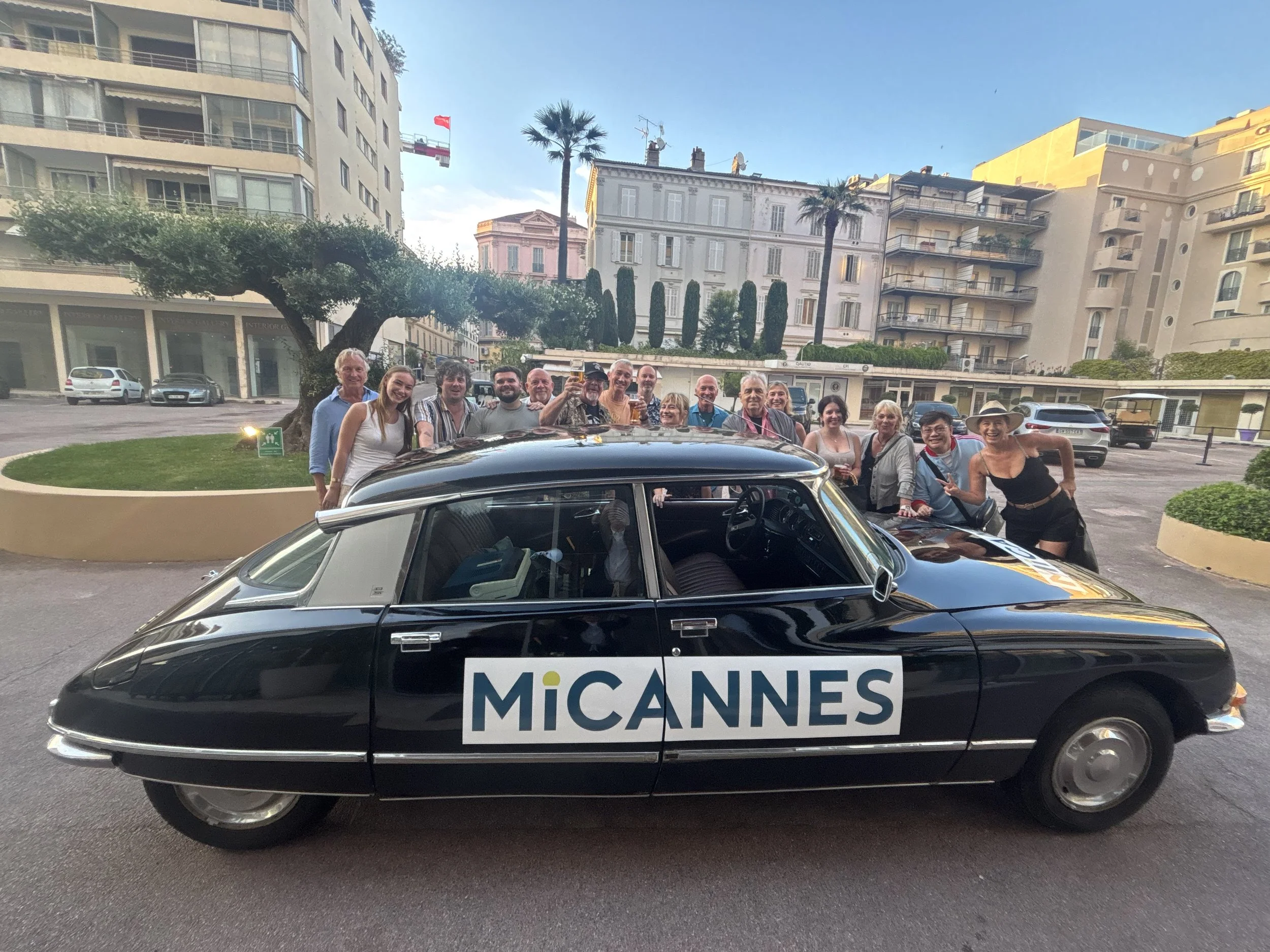
MiCannes '25 a massive success!

MiCANNES ‘25 was attended by record numbers in Cannes in early June.

Apart from the usual wonderful “Croisette networking”, and of course the 17 spectacular artists that showcased at MiCANNES ‘25, the industry enjoyed several fantastic panels hosted at the Mondrian Hotel on the Croisette, as per MiCANNES ‘24.

Highlights included the Catalogue Deals Panel and the 3D CGI Concerts Panel, on Wednesday 4th June. Both panels moderated by Ian Penman, of New Media Law.

For further details check out the Panels here: Panels – MiCannes

And read the amazing testimonials about MiCANNES here: Testimonials – MiCannes

And don’t forget to register for MiCANNES ‘26 now, to catch the “early bird special rate!”

Beyond the Screen: How AI, Monetisation, and Legal Challenges Are Shaping the Future of Gaming

The gaming industry has grown from a niche hobby to a global powerhouse, boasting approximately 3.3 billion active video gamers and generating $282 billion in revenue, according to Exploding Topics. The history of monetised gaming began in the 1970s with simple arcade games like Pong and Space Invaders, which introduced players to interactive digital entertainment. These early successes paved the way for home consoles in the 1980s, with systems like the Atari 2600 and the Nintendo Entertainment System (NES) revolutionising the gaming landscape. Video games became more advanced throughout the 1990s and early 2000s, moving from pixelated graphics to rich 3D environments with the release of consoles such as the PlayStation and Xbox.

It has come a long way since the early days of arcade cabinets and home consoles, now encompassing a vast landscape of games with innovative technology such as virtual reality (VR), augmented reality (AR) and artificial intelligence (AI). Online multiplayer games transformed solitary screen time into worldwide community hubs, with hits like World of Warcraft and Call of Duty turning gamers into global citizens of a digital universe.

One standout example of this evolution is Grand Theft Auto V (GTA V). Released in 2013, this title is not only a technical masterpiece but also a microcosm of the industry's current trends. Its sprawling open-world environment and detailed, dynamic non-player characters (NPCs) were made possible by AI advancements, while its online multiplayer mode, GTA Online, became a financial juggernaut through the sale of in-game currency and items. The game was one of the first to highlight how much revenue could be generated from microtransactions, earning over $1 billion within three days of release and continuing to rake in billions from ongoing content and in-game purchases. GTA V shows how gaming has shifted from one-time purchases to an ongoing service model, where the game lives far beyond its initial launch, funded by player transactions.

Today, gaming is everywhere. Esports, once considered a niche hobby, now rivals traditional sports with packed stadiums, sponsorships, and prize pools that can buy you several Ferraris—or at least a ton of in-game skins. It is no longer about playing a game; it is about living it. But beneath the surface of this booming industry lies a battlefield of legal and ethical dilemmas.

Navigating Legal Frameworks

The gaming industry is increasingly governed by a complex set of legal frameworks, surrounding copyright law, consumer protection, and gambling regulation. Copyright law protects the intellectual property of developers, allowing them to safeguard their work from unauthorised use or distribution. However, the open nature of the internet and the rise of digital content sharing present significant challenges in enforcing these rights, especially when it comes to mods, user-generated content, and live-streamed gaming events.

In GTA V's case, Rockstar Games has had to walk a tightrope between encouraging creativity in the modding community and protecting its intellectual property. While mods have extended the life and appeal of the game, some infringe on Rockstar’s copyright or enable cheats in GTA Online, leading to legal disputes and bans. This highlights the broader legal struggle developers face in a digital world where user modifications can blur the lines between enhancing the game and breaking the rules.

In addition to IP concerns, monetisation strategies—especially microtransactions—are now heavily scrutinised by regulators. The line between in-game purchases and gambling is increasingly blurred in some jurisdictions, leading to calls for stricter regulation of mechanics like loot boxes – the ultimate wildcard which can be highly addictive. This has sparked a global debate on whether governments should step in to protect consumers, particularly younger players, from predatory practices. Several countries are already taking a hard stance. Belgium and the Netherlands, for instance, have declared loot boxes to be in violation of gambling laws, banning their use outright. Other jurisdictions are considering whether these mechanics need tighter regulation to protect consumers, especially minors. Developers and publishers may soon face stricter rules on how these revenue streams can operate—expect disclosures, age restrictions, and potentially, mandatory odds reveal. It is a fine line between fun and exploitation, and the legal landscape around microtransactions is likely to become even more fraught in the coming years.

Game developers and publishers are also navigating issues related to data privacy. Many games now require players to create accounts, linking their data to the game ecosystem. With regulations like the General Data Protection Regulation (GDPR) in the European Union and United Kingdom. Developers will need to be transparent about what data they are collecting and ensure they have airtight security measures in place. The penalties for mishandling data are steep, and no game company wants to be in the headlines for a massive data breach. Worse still, player trust is hard to rebuild once it is lost. If companies want to continue tracking every pixel of your gameplay, they will need to ensure players are fully onboard—and fully protected.

AI: Friend or Foe?

If the Terminator taught us anything, it is that AI is coming for us—and it is starting in video games. Gone are the days when NPCs had the IQ of a potato. Modern game AI can be smart, adaptive, and even a little creepy. Those enemies that duck behind cover or outflank you in Call of Duty? That’s AI getting clever, learning from your mistakes, and making you work for your win. AI is used in several ways, from enhancing game play experiences to improving game development. AI can also generate dynamic game worlds, create intelligent story-lines, or adjust difficulty levels based on a player’s skill.

But AI is not just about making virtual enemies sneakier. It is also transforming the way games are built. Developers now use AI to help generate huge, sprawling game worlds and even craft narratives. The technology can create procedurally generated content, like entire cities or dungeons, saving game developers countless hours and costs, while also allowing for more expansive and immersive worlds.

GTA V offers another example of AI’s impact on modern gaming. Its AI-driven NPCs interact with the player in ways that feel spontaneous and lifelike, whether it’s pedestrians reacting to the player’s actions or police officers strategically hunting them down during a high-speed chase. These AI systems create a more immersive and believable world, blurring the lines between scripted interactions and dynamic, player-driven experiences.

And it is not just behind the scenes. AI is also moderating toxic behaviour. Whether you are crossing the line into uncharted realms of bad manners, AI is there, watching and learning. Companies are using AI to scan chat logs, detect harassment, and slap bans on unruly players faster than you can say, "I was just kidding."

On a more serious note, the European Artificial Intelligence Act (AI Act) came into effect on August 1, 2024, establishing a framework aimed at fostering responsible AI development and deployment across the EU. This comprehensive regulation categorises risk using the following framework:

·         Minimal risk: most AI systems, like spam filters and NPCs in AI – enabled video games, sail smoothly under the radar of the AI Act. While they are free from strict obligations, companies can still choose to level up by adopting voluntary codes of conduct – no boss battle required! 


·         Specific transparency risk: in the realm of chatbots, it is essential that they wear their “I am just a machine” badge proudly. Players should know when they are getting advice from an AI rather than a fellow gamer. Any AI-generated content – think dynamically created game levels – needs to be clearly labelled.


·         High risk: high risk AI systems, such as those powering AI-based medical software or recruitment tools, face tougher challenges, much like facing a final boss. These systems must comply with rigorous requirements, including robust risk -mitigation strategies, top-notch data quality, clear user communication, and essential human oversight. No deepfakes of individuals or shortcuts here!


·         Unacceptable risk: strictly prohibited AI systems, which include subliminal or deceptive techniques, social scoring, and biometric categorisation systems. After all, no one wants to navigate a world where your worth is determined by a social score rather than your epic gaming achievements!

In contrast, the UK has opted for a cross-sector framework built on five key principles: safety, security, transparency, fairness, and contestability and redress. As we adapt to these new guidelines, we can anticipate updated implementation advice, set to be released in April 2025.

The Future

Looking ahead, the gaming industry is poised for even more transformation, driven by emerging technologies such as VR, AR, and AI. These innovations are likely to blur the lines between the virtual and real worlds, creating more immersive and interactive gaming experiences. AI will continue to shape the future of gaming, enabling more sophisticated game design and user experiences.

However, the future also holds legal and regulatory challenges. Governments around the world are expected to increase their scrutiny of gaming companies, especially concerning issues like loot boxes, data privacy, and player rights. The example of GTA V shows that as games grow in scope and complexity, the legal and ethical questions surrounding them will only multiply, from intellectual property disputes to concerns over player spending habits.

Moreover, as AI becomes more integrated into gaming, new ethical and legal questions will arise. For example, who owns the content generated by AI systems in games? If AI can learn and adapt to players’ behaviour, how should privacy and data rights be managed? Additionally, as AI-driven moderation becomes more commonplace, there will need to be transparent and fair systems for addressing false positives and protecting players' rights.

The gaming industry has come a long way since the days of pixelated plumbers and blocky spaceship shooters. What started as a quirky niche of arcade cabinets and 8-bit consoles is now a global entertainment juggernaut, where teenage millionaires are crowned in Esports arenas and players are spending real cash on virtual hats. But with great growth comes great complexity—legal red tape, AI lurking in the shadows, and the never-ending debate over whether loot boxes are a fun surprise or a mini casino. As AI gets smarter, the ethical and legal questions will grow. Buckle up, because the gaming world is no longer about high scores and headshots.


Renae Weir, October 2024

From Inspiration to Infringement: Did 'When I Was Your Man' Plant the Seeds for 'Flowers'?

Copyright infringement claims in the music industry have become commonplace in recent years. In a world where a combination of the same twelve notes is used in most songs, and 120,000 new songs are being released each day, there are bound to be similarities. Many of these cases involve some of the most successful songs in any given year, which is very attractive to a potential claimant seeking a large amount in compensation.

These cases have the potential to damage the reputation of both the artist and the industry and cause unnecessary stress and expense for both parties in dispute. It has become essential for an artist to seek permission from the owner of the work they are taking inspiration from, or even an artist to whom they are paying tribute, to avoid any potential claims. However, there should be a balance between giving credit where credit is due and allowing artists the freedom to create and express themselves, without having the fear of an infringement claim in the back of their mind.


What constitutes copyright infringement

To prove copyright infringement in music, the defendant must have had access to the song, and their song is ‘substantially similar’ to the original work. This definition is quite vague, and to combat this, there are several musicological factors that will be considered when deciding a case. It must be shown that an original musical element from the song in question was taken, meaning it can’t be an element that has previously been used many times before, such as a generic beat. Usually, music experts known as musicologists will be brought in and will use their extensive experience to provide some insight into what constitutes an original element. They will have a deep understanding of chord progression, melody, structure and tempo and will refer to each of these factors when comparing the two songs. They will then give their opinion as to whether any original material has been copied.

As well as reports from musicologists, the court will consider the extent of the songwriters’ access and exposure to the original song. For example, if the two artists played at the same festival, or if one was the opening act for the other on tour, there is a good chance they would have heard the song. In contrast, if the song was written by a relatively unknown artist, it would be difficult to prove exposure. Although, with the rise of TikTok and the easy access to a vast array of music, it has become increasingly challenging to claim that you had no reason to have heard the song before.

Finally, the court may acknowledge the artists propensity to copy other work. If there have been multiple successful infringement cases against an artist, it increases the likelihood that the material in question was copied.


Position in the US

In the past week, Miley Cyrus and her record-breaking song, ‘Flowers’, have become the subject of a copyright infringement claim filed by Tempo Music Investments (Tempo). It is argued that there are ‘significant similarities’ between the songs ‘Flowers’ and ‘When I Was Your Man’ by Bruno Mars, in which Tempo owns a share of the copyright. Tempo claims that there is a resemblance between the chord progressions of the two songs, including the vocal lines, pitch ending pattern and the baseline structure. They also believe that there are obvious similarities between the lyrics of both songs. When ‘Flowers’ was first released, the chorus became an immediate point of discussion on social media, with fans and news outlets picking up on the fact that it seemed to be an answer to each line in the chorus of ‘When I Was Your Man’. The lyrics appear to be a response, for example, “I hope he buys you flowers” becomes, “I can buy myself flowers”. While the lyrics are obviously similar, the question is whether they constitute a copyright infringement.


Position in the UK

Here in the UK, in the recent case involving Ed Sheeran’s ‘Shape of You’, another record-breaking song, the court rejected the claim of copyright infringement. In this case, the court considered whether the post-chorus of the song which includes the lyrics ‘Oh I’ was copied from Sami Switch’s ‘Oh Why’. Musicologists gave evidence in the case and concluded that the similarities were merely a coincidence and there were ‘distinctive differences’ between the two songs. The judge also stated that similarities are only a starting point, and that the claimants had failed to prove the elements were deliberately or subconsciously copied. Despite Sheeran having been sued for copyright infringement twice before, the judge did not find that he had a propensity to copy other material.  The songwriters denied ever hearing ‘Oh Why’ before, and there was very little evidence to contradict this. Upon winning the case, Sheeran stated that these types of claims are ‘way too common’ and ‘damaging to the songwriting industry’ and wishes in future that ‘baseless claims like this can be avoided’.


Potential outcome

Judging by the Sheeran decision, there may be a similar outcome for Cyrus. One would expect the court to find that there is no infringement, as the lyrics are not directly copied, and it is difficult to prove ‘substantial similarities’ in melody. However, the Cyrus case is unique in that the focus of the copyright is on the lyrics rather than the melody. There are several arguments likely to be made by the claimants. There will no doubt be musicological evidence submitted with regards to the chord progression.  As well as this, the claimants may argue that Cyrus and her co-writers had access to ‘When I Was Your Man’, considering its success. Another potential argument is that Cyrus intended to take inspiration from the lyrics in the chorus.

The defence may argue against this and claim that while some lyrics mirror those in Mars’ chorus, the emotional context, melody and vibe of ‘Flowers’ is completely different.  They may argue that ‘Flowers’ is a parody of ‘When I Was Your Man’. If someone creates a parody, they may rely on the fair use exception to protect themselves against infringement claims. However, this argument may be a stretch, as the definition of a parody is ‘an imitation for comic effect or in ridicule’, which doesn’t seem to apply here. However, this case has the potential to create a new category of parody, where a creative response to another song can be protected. They could put forward that the lyrics are a response rather than a copy, like rappers responding to each other in diss tracks. This is a common part of hip-hop culture, a genre in which there are rarely any infringement claims. Perhaps the same leniency should be given to the other genres. They may also mention the fact that Mars’ song was streamed over a million times following the release of ‘Flowers’, resulting in an increase in popularity for a song that was released over a decade ago.


It will be interesting to see the outcome of this case, particularly if the argument of fair use is put forward. If the decision favours Tempo, it could result in huge damages, given the songs success. If the case goes Cyrus’ way, it could make history and set a precedent for songs that are in response to others. This has the potential to change the position in the UK and would undoubtably have an influence on future cases. These cases have become prevalent due to the rise of recording technology, streaming services and widespread accessibility. As the industry is constantly changing, so must the law in this area, to prevent people from taking advantage of the opportunity to make money and to allow artists to reach their full creative potential.

Sarah Buckley, 2024