
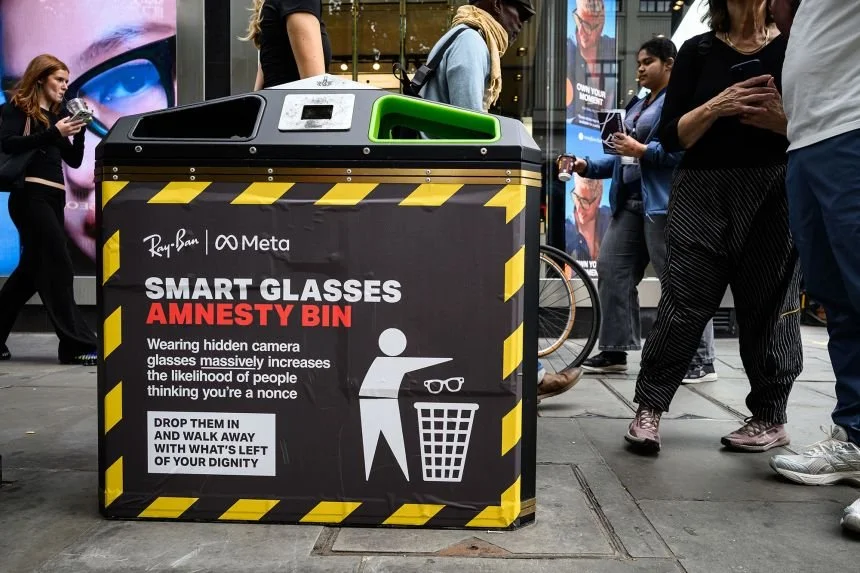
With their neutral hardware, hidden camera, and strategic partnerships with the fashionable labels Ray-Ban and Oakley, Meta glasses may appear to the untrained eye as just another pair of lenses. In fact, the lenses have been the source of considerable controversy – frequently referred to as ‘pervert glasses’. The people of London have made their stance on the matter clear, placing fake, satirical ‘Smart Glasses Amnesty’ signs on public bins, creating stickers that mimic official TfL signage aimed at the wearers of Meta glasses, and downloading the app "ZuckOff" on mass, which warns app-users of nearby smart glasses.
Smart glasses are not illegal. In fact, the specs have had a considerable positive impact on many. They have been revolutionary for the blind community – the glasses can read out visible text from one's surroundings and describe in detail what is going on in the space around the wearer. Aware of the positive impact they were having, Meta donated 15,000 pairs of glasses to a charity for the blind in Ireland. The blind community is not the only community excited by the concept of the glasses – many professions will benefit too. In the travel and hospitality sector, for example, the glasses will enable real-time language translation, and tradesmen and beauticians may benefit from being able to record and share their work as they do it. But it is exactly this – the ability to record what is happening around you and then instantly upload it – that has triggered the negative response, sparking conversations around consent, misuse of information, data protection and legality.
To quote tech founder Liz Hunter, the glasses ‘have rolled back [women's] privacy rights right before our very eyes’. Indeed, a pattern has emerged in which women have been filmed by men wearing smart glasses without their consent, before the footage is then posted on social media. Often the women targeted are unaware that they have been filmed until they find the video posted online. This covert filming has taken place in both public and private settings. In a recent case at Warrington Magistrates' Court, David Williams pleaded guilty to voyeurism after using smart glasses to record a private sexual encounter without the victim's consent.
Data Protection and the UK GDPR
It is one thing for the glasses to capture content; it is another for them to process the information they gather from accompanying their owner around during the days, weeks and private moments. For those who wear their smart glasses to a space which makes their special category data known – health, religion, political opinions, trade union membership, racial or ethnic origin, sex life or sexual orientation – it is vital to understand what is being done with that information. It is also important not to underestimate the ability to establish special category data from daily wear. When the glasses record your journeys, the people you spend your time with, your weekdays and your weekends, the complex system will likely make inferences about special category data.
Data protection laws regulate how this kind of data is used. The UK GDPR applies where its scope is engaged, which it will be unless an activity is purely personal or household. However, if private surveillance includes public information the UK GDPR will apply (C-212/13 Ryneš v Úřad pro ochranu osobních údajů). Therefore, the UK GDPR will apply if the wearer of the smart glasses is using them for work, or to record strangers. If the UK GDPR is engaged, the controller must identify a lawful basis, act fairly and transparently, minimise data, limit purpose and retention, keep data secure, respect rights, and be able to demonstrate compliance.
The easiest way to ensure that the wearers of smart glasses act fairly and transparently is to ensure that the LED recording light is activated at all times. Although Meta have attempted to make it considerably more difficult to disable the recording light, 1% of wearers have been able to do so in the hope of stopping the recording light from showing. Other wearers have obstructed the light altogether. This appears to be a problem that Meta have acknowledged, as on the 24th of September Meta launched an audio-only set of lenses with no camera, which many have seen as a response to the concerns around data protection that have stemmed from the previous lenses.
In an attempt to minimise the data collected, the ICO have encouraged conversation around why recording is needed. Although there may be some uses of the glasses that are necessary in certain industries, it is important to assess whether less invasive methods can be used to achieve the same outcome. Similarly, it is vital to identify a lawful basis if special category data is collected. Continued recording – even for professional purposes – is unlikely to be lawful.
Increase in crime
The glasses have created fear around an increase in crimes like voyeurism, upskirting and intimate recording. As this article has clarified, smart glasses are legal. However, they have been used in illegal ways. In response to a rise in cases in these areas, the intimate image regime has developed – in February 2026, section 138 of the Data (Use and Access) Act 2025 was amended to ensure that the creation of intimate images of adults was a punishable offence.
Conclusion
It is undeniable that technology is developing alongside the law. Statutory provisions governing data protection laws will have to keep developing, and it is safe to say that in the coming days, weeks and months, the landscape will be different. The recent introduction of glasses without a camera demonstrates that tech companies too are in unknown territory – is this a strategic step away from the model that caused an uproar, or is it a continuation of a product that is the first of many?
Dolly Payne, September 2026