
It is highly likely that in the past half decade, you have unknowingly listened to music made partially, even entirely, by AI. Whether it’s a producer using AI instruments and vocals (1) or completely AI-generated artists (2), music is rapidly beginning to include more sounds created on AI driven software.
With listeners expressing their concerns when it comes to identifying AI usage in their music, a similar issue emerges regarding copyright. For example, in what way is using recordings to train music-generating models copyright infringement? Or how should the use of such software be made clear as well as credited? However, what if these seemingly modern concerns didn’t emerge as recently as one would’ve thought.
Going back 70 years to 1956, long before any Zoomer used ChatGPT on an iPad, chemistry professor Lejaren Hiller was busy tinkering with the Illiac I, the University of Illinois Urbana-Champaign’s only computer at the time. Instead of cracking codes or opening search engines, Hiller had programmed the computer to generate its own musical compositions, using what is now known as algorithmic composition. The piece String Quartet No 4, originally titled the Illiac Suite, was the first substantial piece of music to be composed not only on, but by a computer. It was performed by four students, one of whom remembers a packed auditorium of people “who showed up to see what the monster of a computer could do” (3), with one of Heller’s former students noting that he had “touched a nerve in a very deep way”.
Even then, at the very first instance of something that resembled technology to come, the reaction was one of apprehension. What does this mean for the future of music? Would computers eventually take over the arts? At what point won’t we be able to tell the difference between what a human and a computer makes (4)? Before that point however, computers were busy chopping up and changing old sounds and making them into new ones.
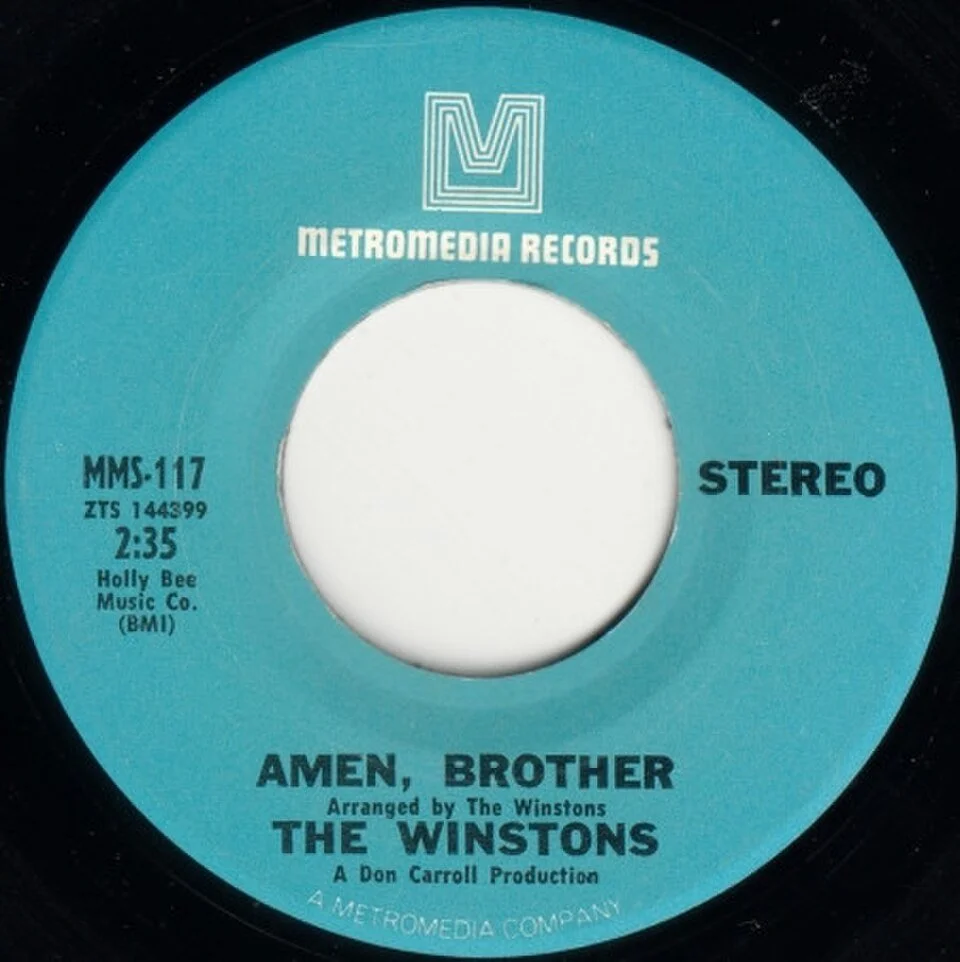
In 1969, Gregory Coleman played a 7 second drum break that would eventually be the most heard drum sound in the world. The track he played on, ‘Amen, Brother’ by American soul group The Winstons, has as of today been sampled on over 7000 tracks, making it the undisputed most sampled track in history (5). From hip-hop to jungle, drum and bass to rave music, a wide span of genres utilised the drum beat and made it their own, such as a rap loop on Salt-N-Pepa’s ‘I Desire’ and NWA’s ‘Straight Outta Compton’ or chopped up on jungle tracks like Lennie De Ice’s ‘We are I.E.’ (6).
The beat, coined the ‘Amen Break’ most notably re-emerged on a 1986 compilation named Ultimate Beats and Breaks, while also appearing on other sampling collections. With the 80s boom of hip-hop and electronic music, record companies created these compilations including songs with beats that were good to scratch and mix. These companies, however, were effectively selling the ‘Amen Break’ as their own copyrighted material, and by the 2000s multiple copyrights existed for the track. The lack of strict copyright laws at the time meant that any original artist was unlikely to see a reward for their work. On the other side of the coin, this flexibility enabled the ‘Amen Break’ to inspire thousands of minutes of music and new genres, far beyond those original 7 seconds.
Hence, while the free use of the ‘Amen Break’ would contribute to the development of multiple music scenes, Coleman would see no royalties or reward in his lifetime, dying homeless and penniless on February 5th, 2006. In 2015, a crowdfund raised £24,000 to give to The Winstons’ frontman Richard Spencer, as a rightful reward for their track’s success (7).
In the modern day, have we not returned to a similar issue? Just as music copyright law didn’t keep up for the likes of Coleman in the age of sampling, we’ve seen the law once again lag behind the booming growth of AI music software. However, could intense scepticism around AI as well as copyright crackdowns lead to regulatory control that inhibits potential creativity?
Both Suno and Udio, the two most popular AI music generators, have been sued by Universal Music Group (UMG) and Sony Music Entertainment amongst multiple other entities in the past 2 years for copyright infringement. The original claims state that their AI models had been trained on copyrighted music without authorization, which after 2 years of discovery has led to both UMG and Sony adding over 60,000 recordings to their lawsuits against Suno (8). Furthermore, despite having an initial bid denied, Sony have once again sued Udio asserting over 30,000 recordings have been illegally copied (9). The result of these cases is likely to shape the future for creative AI models, deciding whether training these models on data sets including copyrighted recordings without license is deemed fair use or not.
In opposition to the labels, the AI companies point to recent rulings such as Bartz v. Anthropic, where the use of books for AI training was ruled as fair use, as well as Kadrey v. Meta Platforms where a similar ruling was found. In the Anthropic case, the judge deemed that the AI’s output was not similar enough to the source books, calling the use “spectacularly transformative” (8). However, in the cases with Suno and Udio, the argument remains as to what extent the music created is too similar to the recordings used to train them.
There may be answers arriving soon, especially as previous claimant Warner Music Group (WMG) settled and launched a joint venture with Suno to create data sets including licensed tracks for their AI model (10). UMG have similarly started to settle with Suno and are in the process of licensing tracks for their data sets also. Perhaps then, a suitable compromise will be met that enables these AI music programs to operate legally. However, if artists do not approve of their music being used for these models, they’ll be left with less recordings to train from and will likely be less effective tools. But if doing so protects these songs from being copied an infringing way, then it is just as important to protect artists and their work – protected so that the only time their work is copied, they’ll be rewarded accordingly.
For those artists who are using these AI programs as either inspiration for their work (11) or as tools for their creative process (12), a future where these programs are both law and label approved could be a positive for enabling more streamlined creativity for musicians wanting to use these tools. Although, a further issue then emerges regarding transparency about AI use, with listeners wanting to know the extent to which their music is AI generated (13). Then with copyright, if artists do use these AI music-making platforms, to what extent is their music their own, or is owned by the companies behind these softwares.
With this, perhaps we should think back to the ‘Amen Break’, how it led to the creation of new songs and genres inspiring countless musicians, but also how its original creators saw none of the success land in their own hands. But what if the story wasn’t so simple. What if Coleman didn’t even own the drum break he played. The song ‘Amen, Brother’, is in fact an up-tempo adaptation of ‘Amen’, a gospel tune by Jester Harrison (14). In this case, if every song is inspired, copied, or updated even before these AI programs existed, then is the process of transforming the old into the new not just the process of human creativity? What is being judged then, is truly how similar the AI process of creativity is to the human one. On the one hand, we must encourage this creativity and allow for new music to be made. On the other, we must protect the music and artists that have already been.
Theo Grange, July 2026
1: https://aristake.com/ai-tools-musicians-study/
2: https://www.rollingstone.com/music/music-features/timbaland-new-artist-tata-ai-1235356185/
3: https://www.theguardian.com/music/2021/dec/07/he-touched-a-nerve-how-the-first-piece-of-ai-music-was-born-in-1956
4: https://newsroom-deezer.com/2025/11/deezer-ipsos-survey-ai-music/
5: https://www.whosampled.com/The-Winstons/Amen,-Brother/
6: https://www.youtube.com/watch?v=wusSmIV-FE8 https://www.youtube.com/watch?v=TMZi25Pq3T8 https://www.youtube.com/watch?v=rtokNN1HZ9A
7: https://www.vice.com/en/article/amen-breakbeat-fundraiser/
8: https://www.musicbusinessworldwide.com/why-a-fight-over-61000-recordings-could-shape-the-future-of-ai-music-licensing/
9: https://www.musicbusinessworldwide.com/sony-music-files-new-lawsuit-against-ai-platform-udio-asserting-over-30000-sound-recordings-a-judge-barred-it-from-adding-to-its-original-case/
10: https://www.bbc.co.uk/news/articles/cjdrl7lr039o
11: https://www.hollywoodreporter.com/music/music-news/how-many-musicians-use-ai-1236616294/
12: https://aristake.com/ai-tools-musicians-study/
13: https://www.smithsonianmag.com/smart-news/ai-music-is-already-here-to-protect-human-artists-the-record-industry-proposes-labels-for-it-like-those-for-explicit-lyrics-180989128/
14: https://www.ethanhein.com/wp/2011/the-amen-break/